$3.5B lost to impersonator scams last year: Can you still spot a fake business text?


Americans lost $3.5 billion to impersonator scams last year, according to the Federal Trade Commission (FTC), across every channel, including texts, phone calls and social media. Business impersonation accounted for nearly $1 billion in that total. With AI, those scams are getting harder to spot, and many legitimate business messages now look, to a recipient’s eye, identical to a fraudster’s. A growing number of companies now reach consumers through channels that verify the sender’s identity up front, and show proof right in the message. Below, Sinch looks at what it all means on the receiving end.
Scammers have taken over your favorite mobile messaging channels
SMS is available on nearly every phone on the planet, with no download, no account, and no internet connection required. 98% of American adults own a mobile phone, Pew Research Center reports, so a text message can reach nearly anyone. That makes it the closest thing to a universal channel.
WhatsApp works on a similar scale in many countries: It’s the world’s most popular messaging app, with more than 3 billion people using it every month, according to Meta. Anyone with an internet connection can set up an ordinary WhatsApp account in minutes. Its popularity is also growing in the U.S. In July 2024, WhatsApp passed 100 million monthly active U.S. users.
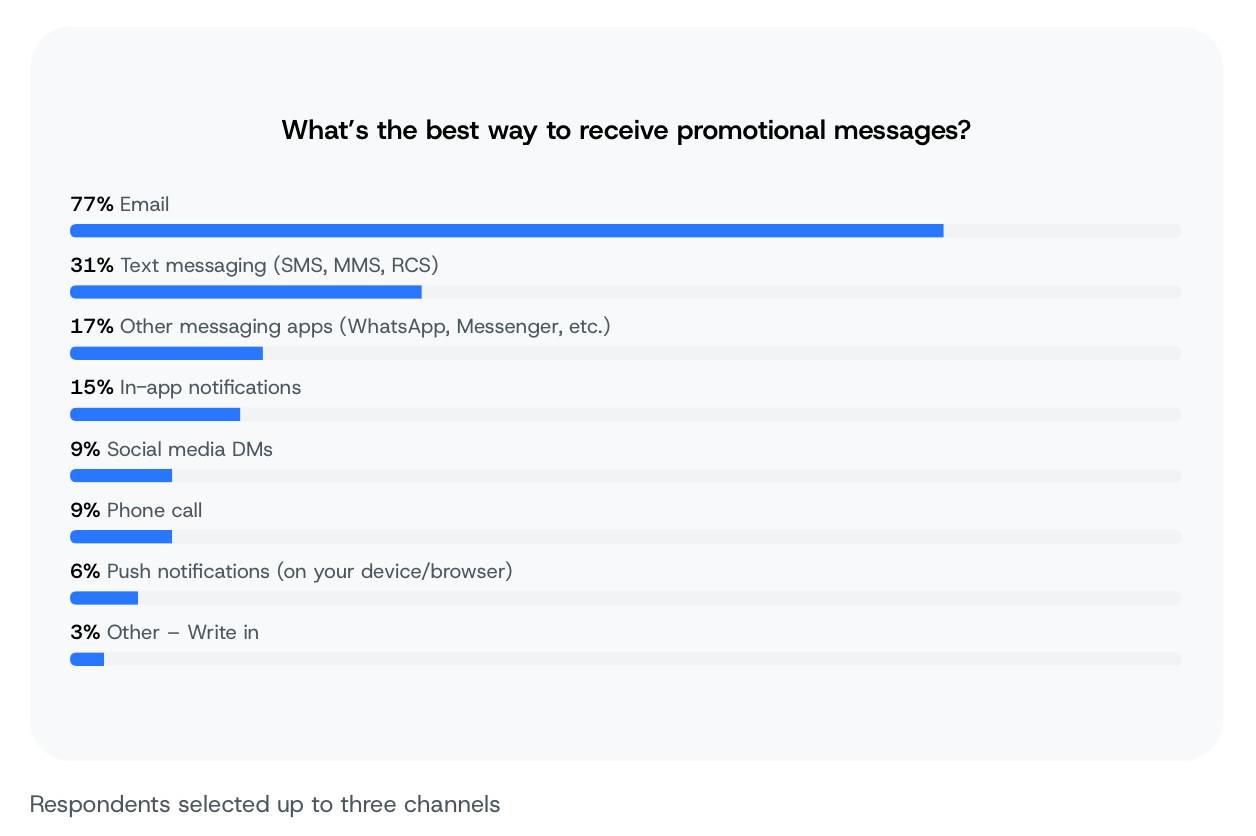
Consumers actively want brands to reach them this way, too. Sinch research found that 58% want the ability to choose their preferred channel when they opt in to hear from a business, and mobile messaging is a real part of that mix: A combined 48% of consumers want to receive promotional offers by SMS or other messaging channels. This expectation is exactly what fraud operations exploit. A scam arriving through a channel where people already expect to receive brand communications starts one step ahead.
No one is off-limits, and the losses keep climbing
In the first half of 2025 alone, WhatsApp shut down more than 6.8 million accounts traced to criminal scam centers, including networks Meta said were using AI-generated messages to reach victims.
On the SMS side, the numbers are just as concerning: according to the FTC, Americans reported $470 million in losses to text scams in 2024, more than five times the 2020 figure, despite a decrease in the number of reports. Still, SMS remains one of the best channels for reaching customers on a global scale, which is why fighting “smishing,” or SMS phishing, has become a rising priority for businesses that rely on it.
Text scams involving brand impersonations have become familiar in the headlines. In February 2026, a couple outside Houston lost $75,000 in a matter of hours after a text arrived that looked like a fraud alert from their bank. It wasn’t.
And these scams aren’t limited to banks or delivery services and other familiar impersonation scenarios. In 2025, a software company issued a public scam alert after fraudsters began impersonating its employees on WhatsApp and Telegram, using fake documents to disarm suspicion.
In June 2026, the FTC itself warned that scammers were posing as its own employees over text and WhatsApp. Some used fake employee IDs, convincing victims to transfer money to protect it from a scam that never existed.
AI is erasing the tells people used to rely on to spot scams
Until recently, brand impersonation had a tell: Scam texts arrived with broken grammar, awkward phrasing, and generic content instead of relevant information. Those signals are disappearing. Generative AI can now produce a scam message in fluent English, or any other language, personalized with details scraped from data breaches or public records, at a volume no human fraud operation could match.
The FBI tracked AI-related scams for the first time in its 2025 crime report; it recorded $893 million in losses across schemes involving voice cloning, deepfake video, and AI-generated messages.
According to Sinch research, more than half of consumers globally (53%) say they’ve received a legitimate message from a brand in the past year that they initially found suspicious. This means a real brand message might get ignored because it looks like a scam, while an actual scam might get acted on because it no longer looks like one.
Verified messaging adds a visible layer of trust
The telecommunications industry hasn’t ignored this problem. In the U.S., businesses already have to register their identity with carriers before they’re allowed to send text messages to consumers at scale. In 2024, over 55 billion scam and spam robotexts were blocked. The CTIA, the industry’s trade group, published its first Messaging Security Best Practices in October 2025, introducing new guidance on consumer consent and wireless messaging abuse. But none of this is visible on the receiving end. To a consumer, a compliant business text might look exactly like a scammer’s.
That’s the gap verified messaging is attempting to close. Businesses are increasingly turning to channels like RCS for Business, the technology upgrading text messaging on Apple and Android devices, and WhatsApp Business Platform, both of which require third-party verification to message consumers at high volume.
With RCS, a business must register as an official sender agent and have its intended use case approved by its carrier or Google (the company behind RCS), or both, in order to be able to send any message. Apple also began rolling out support for RCS business messaging for iPhone in October 2024. After approval, every message displays proof that the recipient can actually see:
- The sender’s name, instead of a phone number
- Official branding, like the brand’s logo and colors
- A visible verification tag, confirming the message is coming from a legitimate company
On WhatsApp, anyone can set up an account on the free standard app or the separate WhatsApp Business app used by small businesses. The WhatsApp Business Platform, however, requires senders to go through a verification process with Meta before they can reach large numbers of consumers. It involves submitting official documents such as a business license or tax registration matching the company’s name and address. Once a sender clears that check and has its display name approved, the name appears in the message instead of a phone number, even for recipients who haven’t saved them as a contact.
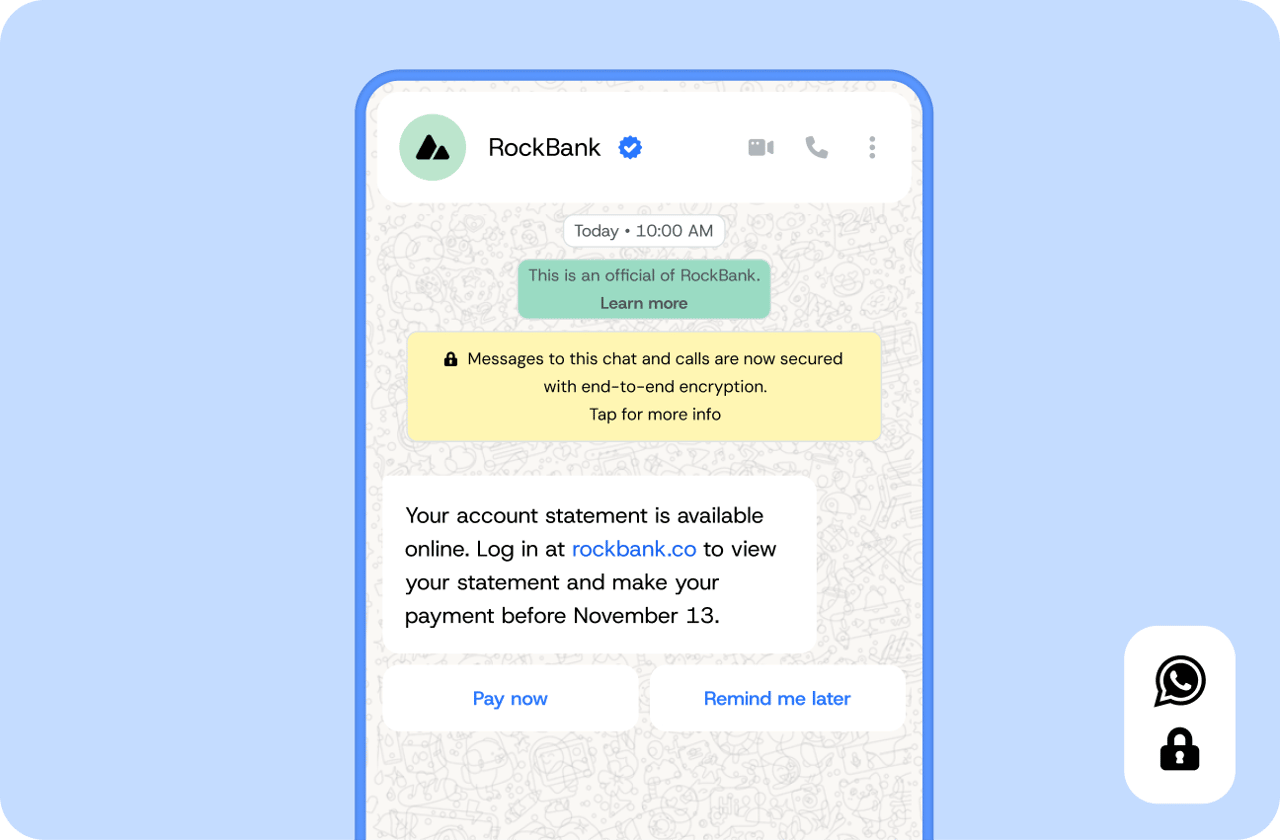
The blue checkmark can be granted through a separate, additional step, reserved for businesses that Meta deems well-known enough to qualify. That checkmark is the one piece a scammer can’t copy: It isn’t part of the message, it’s assigned by the platform after verification.
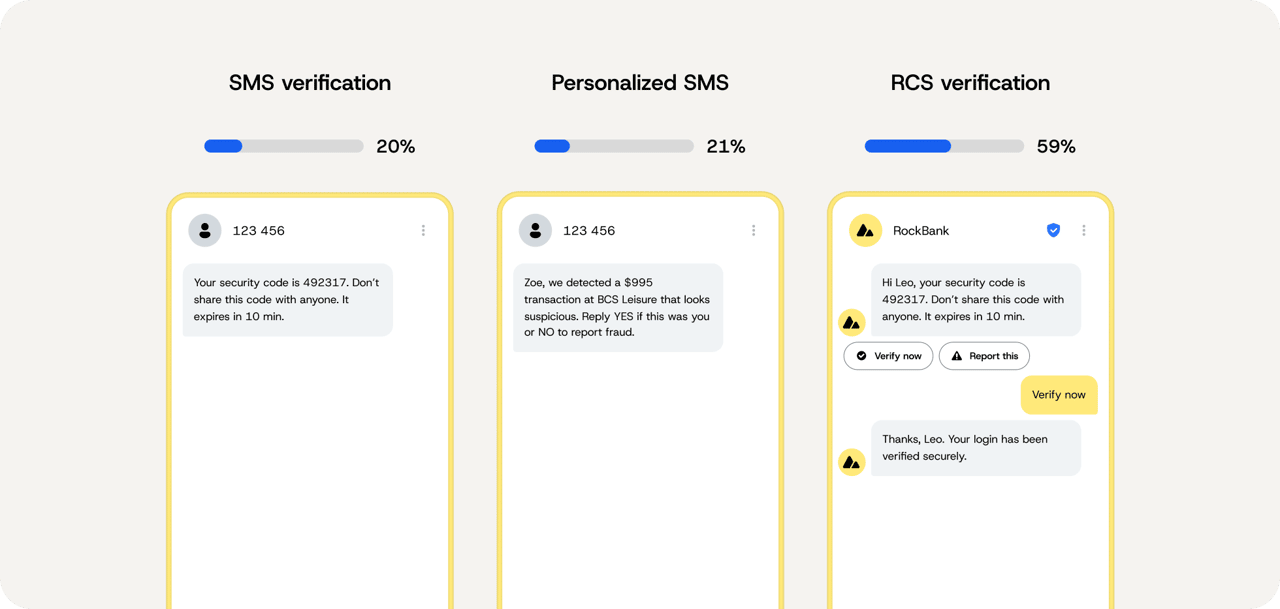
Verified messaging measurably impacts consumer trust. Seventy-nine percent of consumers globally say a logo and checkmark make a message feel more trustworthy, according to Sinch research. In a three-way test, Sinch asked consumers to pick the version of a verification code message they’d trust most: a basic SMS, a personalized SMS, or an RCS message. RCS was chosen by 59% of respondents.
As for business adoption, Sinch research found that 26% of retailers have already adopted RCS, as well as 49% of financial services companies, and 87% of business leaders across industries are at least familiar with it.
Red flags to watch out for, no matter the channel
Does this mean you should stop trusting every message from a business that doesn’t have a checkmark? No. More than 200 million businesses use the free WhatsApp Business app, which doesn’t require any verification, and 75% of businesses use SMS marketing, according to Sinch. This means that no checkmark isn’t automatically a red flag. But here are a few signs that suggest you should think twice before acting on a message:
- You haven’t signed up to receive messages from this sender (legitimate companies typically ask for opt-in first).
- It’s pressuring you to share sensitive information or take immediate action.
- The sender’s WhatsApp profile is blank or shows irrelevant or generic information.
- You received an unsolicited verification code, without attempting to log in, update your account, or make a payment.
Trust in mobile messaging is decided in seconds. As consumers grow more suspicious of everything that lands on their phone, messages carrying visible proof of identity are more likely to be trusted and acted on.
This story was produced by Sinch and reviewed and distributed by Stacker.
