The man behind some of your favorite scents

Arabelle Sicardi
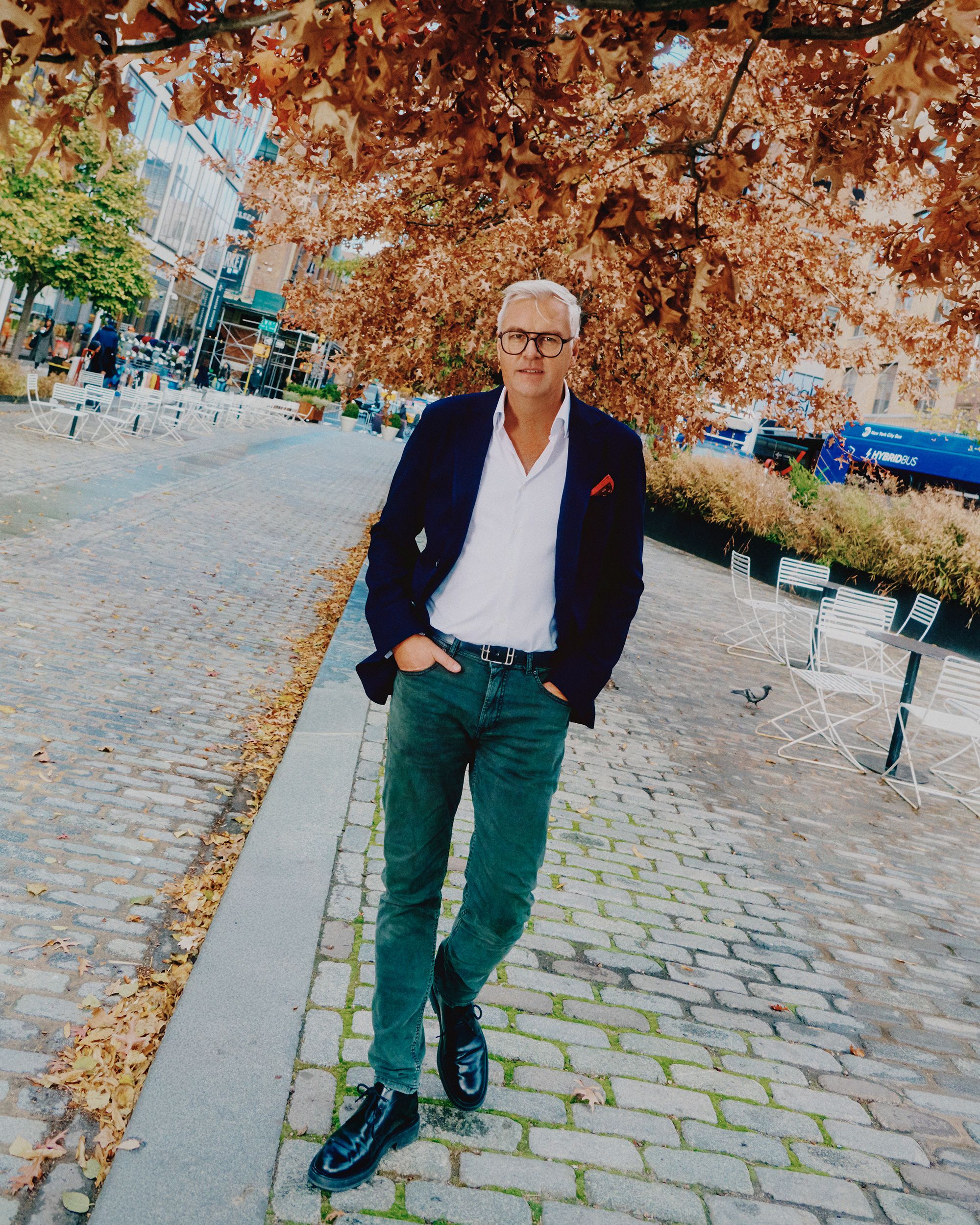
Frank Voelkl is a well-dressed German man you’d walk past on your Manhattan commute without a second thought. But his work has likely been on your neck, your vanity, your partner or your ex. If you’ve worn fragrance in the last two decades, you’ve probably worn Voelkl. He is, arguably, the perfumer of the millennial olfactory oeuvre: Le Labo’s Santal 33, Glossier’s You, Phlur’s Father Figure, scents for Ariana Grande and Jennifer Lopez, work for Dolce & Gabbana, Calvin Klein and more.
Voelkl is a master perfumer at DSM-Firmenich, one of the world’s leading fragrance houses — and is only the 16th in the company’s century-long history. It’s a rare distinction — there are more registered astronauts than master perfumers, who sit on the councils that choose which materials to pursue next, so you smell their predictions years later. “I would say we’re the ultimate experts,” Voelkl says, with exactly the right amount of modesty and fact.
Voelkl’s perfumes are recognizable: clean but not sterile, woodsy but transparent, airy and modern without being clinical. The hugely popular “skin scent,” freshly washed skin remembered through a romantic haze, is practically defined by You and Father Figure. A bottle of You sells every 40 seconds, according to Glossier. Santal 33 turned creamy sandalwood into a sexy, mineralic fog. At its peak, whole blocks of Manhattan trailed its sillage.
He likes almost everything he makes, but he wouldn’t wear all of it. His own taste runs to smokey, leathery materials, which he sneaks in at “very, very small, subliminal” doses. Any more, and, he finds, people read them as fire, danger, shadow.
A clear vision — and nose
Perfume is rarely given such airs outside of its own ecosystem – but the master perfumer designation creates a distinction the beauty world recognizes at a global scale. Masters advise the companies they work for on decisions both big and small. They sit on the councils that decide which materials to pursue next. You smell what they’ve predicted, years after they made their choices known. A master determines pathways to possible fragrant futures — and near ubiquity and instant smell-recognition is a hard skill to replicate.
Voelkl has learned that success relies on the success of a workshop – a team of many voices, not just his own. “As a perfumer, we work with managers, evaluators, sales, marketing, the clients themselves. Our work is being edited. I see the evaluators as editors.” They often tell him a composition is too green or smokey to be commercial. “I listen to everybody and absorb the comments.”
But it’s up to him, in the end, to decide which notes to take, and how to stay on the path to creation with the people who walk alongside him. He quotes a colleague’s advice often given to their trainees: “Don’t take the bus until you know where you’re going.” He explains his version as the following: “Hold a clear destination, stay open to a place nobody else has been, and accept the collaborators walking the road with you.” It is a matter of intuition and collective knowledge – and knowing when to listen to your own gut.
“In the end, you’re alone. You’re alone as a creator, and you have to make that call.”
The vanishing palette
A perfumer’s raw materials are in a chaotic stage of both perpetual innovation and rapid disappearance. The industry is in the middle of a structural reformulation wave because of it. If you’ve noticed your longtime favorites being re-released recently — they’ve been swept up in this situation, and it’s been years in the making.
From a chemist’s first search to the perfumer’s modification exploration, there are years and millions of dollars of research before the customer gets wind of anything happening. “You have to be five, ten years ahead — easily — in your thinking and in your strategy,” reflects Voelkl.
Part of Voelkl’s job as a master and Senior Perfumer is to guide the research around the research and preservation of certain smells. Because certain natural fragrant materials are disappearing, and it happens more often than it has in past decades. Bay oil, for example, was wiped out almost entirely by Tropical Storm Erika and then Hurricane Maria hitting Dominica, where 70% of the global supply was produced. Natural disasters have devastated the distillery network. “Since then, we don’t have bay oil anymore,” Voelkl says, looking out the window. It is the material he misses most, and for a specific reason: “it smells like metal”, the only ingredient on his palette that did. He’s been searching for a replacement for years. A new old-spice-family material comes close, he says, but fragrance still on the market had to be quietly re-engineered around the absence.
Other losses are regulatory. Fragrance compounds like Lilial and Lyral — “my fetish floral,” he calls the latter, a floral that lasts like a musk — are effectively off the table. One ingredient changing status sets off a chain reaction: Galaxolide, he predicts, will likely be gone from fragrance within five to ten years, another material in a veritable ocean of fragrance. “It’s another wave coming.” The wave never quite stops, and so the reinvention continues. Your favorite perfume, reinvented in ways you can smell but can’t quite spell out. Voelkl is there, lining the molecules up just so.
You smell the success stories, but failure is inevitable
While Voelkl’s work feels omnipresent in beauty stores likes Sephora and Ulta for his work with PHLUR, By Kilian, and Marc Jacobs – the smellscape of makeup shopping, really — if you ask him about his hit rate, he shrugs it off. “Statistically, I haven’t won that many briefs,” he deflects with a half-smile. “You’ll never know about the ones I didn’t win.” To date, he has more than 200 perfumes to his name. For context, there are entire years in which only 200 perfumes were ever released at all. The man is booked, even if rejections litter the laboratory floor. The wins make millions of dollars per perfume.
“Sometimes those briefs are big, big projects you get very invested in. You do have to be emotionally involved to create. And sometimes they don’t go through, and you have to deal with that. It happens certainly more often than being chosen. You have to remove yourself emotionally,” says Voelkl. Like any artist seeking opportunities, rejection is part of the process.
He has no batting average pinned to the wall and resists the idea that all briefs are equal. Some carry commercial weight, others the thrill of introducing a brand. There is, he admits, a private checklist. “I never did one for Yves Saint Laurent. I never did an Armani. I would love to,” he notes wistfully. In his head, there’s a Hall of Fame shelf with gaps in it, after more than 20 years of near ubiquity.
For centuries, the perfumers behind the bottles were rarely listed anywhere to the public eye. Incredibly successful brands like INITIO and CREED still demur from divulging the perfumer’s they work with for their launches. The myth of the brand is paramount. But it’s becoming more of an industry norm for perfumers to not just be credited but treated as celebrities in and of themselves, their portraits shown alongside their finished work at events and unofficial merch is sold in their name on TikTok shop. Brands like Frederic Malle, Essential Parfums and the new brand Anecdote by Artists list the perfumers prominently alongside the name of the perfumes. Most of Voelkl’s work has been behind the curtain — known to the industry, not quite unlisted, but not front of bottle, either.
But you can, in the end, create many successful perfumes and never be deemed a master of your field. What really leads to the title? Fragrance should leave a lasting impression. “You must be creating work that added to the map,” he explains. The second is character. “We are at the heart of it all.”
The-CNN-Wire
™ & © 2026 Cable News Network, Inc., a Warner Bros. Discovery Company. All rights reserved.
