Voyager 1 will reach one light-day from Earth in 2026. Here’s what that means

By Ashley Strickland, CNN
(CNN) — Voyager 1, NASA’s deep-space probe, could soon become the first spacecraft to reach a historic milestone. In November 2026, the probe will be one light-day from Earth.
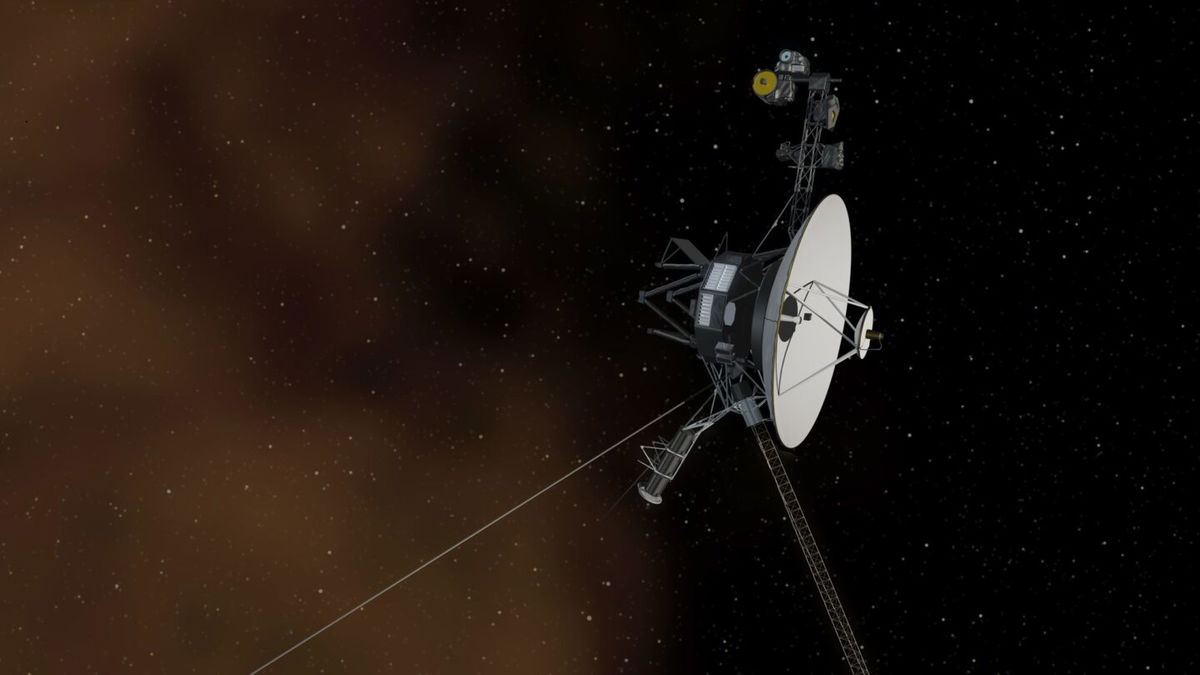
Launched in 1977, Voyager 1 is the farthest spacecraft from our planet, currently exploring interstellar space 15.8 billion miles away.
The term light-day refers to the distance at which it will take 24 hours for a signal or command traveling at the speed of light to reach the spacecraft from Earth, said Suzy Dodd, Voyager project manager at NASA’s Jet Propulsion Laboratory. One light-day is equivalent to 16 billion miles (26 billion kilometers).
So if Voyager’s team is asking the spacecraft to do something once it reaches that point, it will take another day for Voyager to respond.
“If I send a command and say, ‘good morning, Voyager 1,’ at 8 a.m. on a Monday morning, I’m going to get Voyager 1’s response back to me on Wednesday morning at approximately 8 a.m.,” Dodd said.
Voyager 1 and its twin, Voyager 2, are the only spacecraft to operate beyond the heliosphere, the sun’s bubble of magnetic fields and particles that extends well beyond the orbit of Pluto. After decades in space, both have had to turn off several instruments, but they are using their remaining tools to study this uncharted territory and provide data that could inform future missions.
There are many challenges that come with staying in communication with such far-reaching probes, but Dodd and her team are taking necessary steps to ensure that their “senior citizens” reach their 50th anniversary in 2027.
Staying in touch over cosmic distances
Launched on a journey to explore Jupiter and Saturn, Voyager 1 has been traveling away from Earth on the same trajectory and at the same speed — 38,000 miles per hour — since its flyby of Saturn in November 1980.
With an understanding of Earth’s location relative to Voyager 1, the spacecraft’s speed and its trajectory, engineers are able to calculate how long it takes a signal to reach the probe.
For example, Voyager 1’s trajectory after the Saturn flyby took it up and out of the plane of the planets after it passed Saturn, while Voyager 2 passed over the top of Neptune after its 1989 flyby of the ice giant and moved down and out of the plane of the planets. Neither probe has had a trajectory adjustment since their last planetary flybys, meaning that both have been on decades-long uninterrupted cruises.
Voyager 2 isn’t expected to reach one light-day from Earth until November 2035, and even the most ambitious estimates suggest the spacecraft won’t be operating then. But both probes keep surprising the team.
Every day, as the oldest functioning spacecraft, the Voyager probes hold a record just by continuing to operate.
But it hasn’t been an easy process.
The probes send back data at a very low 160 bits per second, or a data rate similar to dial-up internet, Dodd said.
“The distance that we are away from the Earth takes much longer to get a signal there, and the signal strength just dissipates,” Dodd said. “It takes multiple antenna arrays to gather that signal back.”
The low data rate means that Dodd and her team receive sparse information about the health of each spacecraft, and if there is an issue, they aren’t able to respond quickly.
However, both Voyagers are designed to be self-sufficient with plenty of onboard autonomy so they can save themselves if things go sideways billions of miles from Earth.
“If they get something going wrong, they can put themselves in a safe state so that they can wait until we’re able to talk to the spacecraft and figure out what the problem is and resolve that issue,” Dodd said.
Why the Voyager probes endure
For years, the team has made tough decisions to ensure the probes operate for as long as possible, Dodd said. That means turning off engineering systems and instruments to conserve power and ensuring that the spacecraft remains warm enough to function.
In order for the Voyager probes to keep communicating with Earth, their antennae must also be pointed at our planet.
If propellant lines freeze on either probe, causing the antennae to point elsewhere, “we would lose the mission because we could no longer get a signal to the spacecraft,” Dodd said.
And it’s not just about the Voyager probes continuing to fly — they need to operate with scientific instruments.
Before their 50-year anniversary in 2027, both spacecraft will likely need to have additional instruments and systems turned off. The team is hoping to keep the Cosmic Ray Subsystem running on Voyager 2, as well as the magnetometer and Plasma Wave Subsystems on both spacecraft. The instruments would enable both probes to essentially function like weather satellites in interstellar space, sensing the environment they’re traveling through, Dodd said.
Scientists are interested in understanding how the sun’s magnetic field changes and interacts at the heliopause, the boundary of the heliosphere where hot solar wind streaming from the sun meets cold interstellar space.
Think of the heliopause like the shoreline of an ocean, Dodd said. Wading into the water reveals ripples, waves and other changing factors the farther you travel from shore, and at some point, things become more stable. The Voyager probes are measuring the ripples, or interactions between the heliopause, our sun and interstellar space, the farther the spacecraft travel from the sun.
“What’s important is operating with these science instruments as long as possible to make that map of what changes as you get away from the sun,” Dodd said.
Dodd feels confident that at least one of the spacecraft can keep going for another two to five years. The process of enabling the unprecedented missions to endure gets harder every year, she said.
But Voyager has a remarkable team behind it, including NASA retirees in their 80s who advise on specific subsystems and team members so young that even their parents weren’t born when the probes lifted off.
“That kind of intergenerational effort on Voyager is really rewarding to see,” Dodd said. “I love these spacecraft. They’re ambassadors for us here on Earth.”
The-CNN-Wire
™ & © 2025 Cable News Network, Inc., a Warner Bros. Discovery Company. All rights reserved.